Brazilians have long been seen as an apathetic and passive people, who try to carry on with their daily lives in the face of the knowledge that politicians have always been, and will always be corrupt. But this has changed.
The prospect of mega events, such as the Roman Catholic World Youth Journey, the FIFA Confederations Cup, the FIFA World Cup and the Olympic Games (this last one in the city of Rio de Janeiro only) have opened the eyes of many citizens, who have begun to discern the invisible hands of corrupt politicians and big corporations who are acting behind the scenes and draining public money into facilities that will serve mostly the ones who are already rich and powerful.
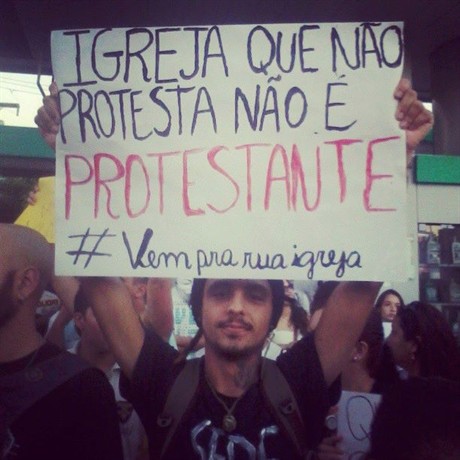
I do not mean to say that such events are bad per se. However, if they are to bring long lasting benefits for Brazilians, public money invested in mega events infrastructure (most notably sports arenas, temporary housing for athletes, press and referees and transportation hubs) must be properly planned. However, what we have been seeing in the last few years is a lot of taxpayer money being spent in overvalued public works, which never meet the initial budget and deadlines, and always require extra investments since “international bodies” demand it.
Also, many of these works were designed to be built on slums and poor neighborhoods, in a deliberate attempt of getting them forcibly removed and replaced by gentrified neighborhoods that benefit no one except for the housing market, which has enjoyed immense average price growths in the last years. In fact, the price of property in Brazil has risen so much that it is absolutely impossible for many citizens (including those expelled from their houses with nothing but a small compensation) to afford decent living with easy access to work.
Of course Brazil has social policies. The country is well known for its programs to provide housing, basic healthcare and money transfers to those in extreme poverty. But, citizens are gradually realizing that assistance for the poor is too little, compared to the potential possibilities the country has in terms of revenue and assets.
Take housing for example. It is true that programs such as “Minha casa, minha vida” (my house, my life) have provided access to simple housing to the extreme poor all over the country. However, those houses are very often extremely small, and far away from urban centers. They are far from public education, public hospitals and city centers where most job offerings are. Also, so far, there are still many slums that haven't been improved, or replaced by proper projects. In some dramatic cases, like Recife (a World Cup main location), the number of inhabitants living in slums reaches almost 40%. Public works for mega events could have been devised to leave a legacy in terms of housing for the poor, but it does not. In Rio, which is expected to host thousands of people for the Olympic Games, the many apartment units which will house athletes, referees and the press have already started to be pre-sold for prices no less than US$ 200,000.00 for the simplest and smallest basic 2-bedroom apartment unit. The redeveloped docklands area, of which almost 2/3 of the property found there had been owned by different governmental spheres, is being gradually given away to private developers, who are turning it into the newest business neighborhood, with expensive waterfront condos and even a 5-tower World Trade Center branch.
Transportation is another key issue in a country that saw a dramatic rise in people living in cities. Bus and metro lines are deficient in many aspects. Traffic jams are constant and commutes can take hours, especially for those living in poorer neighborhoods. Mega events were expected to revitalize public transportation systems, but what we have seen are huge investments in new lines that will be useful only for linking hotel districts and stadiums. Again, most commuters will not benefit from these new lines.
At a moment like this, with high property speculation and an unstable economic system worldwide, the State is expected to intervene in order to guarantee basic standards of living to all. But the truth is that past governments have gradually reduced their size by leasing property, facilities and attributions to the private market. Stadiums, metro and bus lines, airports, ports and even federal roads are being leased to large for profit corporations. This, of course, comes with an automatic increase in service prices. In the last decades, we have seen with our own eyes public buildings and public land being gradually sold to the private sector, instead of being reused, or redeveloped, for housing, education and healthcare.
People did protest, but these protests were isolated. Last year, a major strike happened in the Public University System, for example. The difference is that we are now facing a unified protest, in which all classes, all sectors and all people are fed up with the corruption and inequality and want to see changes. The last straw was the recent raise of bus and metro prices in several cities around the country, coupled with the extra works for the Confederations Cup (which is happening right now). People are just tired of getting the crumbs, while politicians and rich entrepreneurs turn public money into their own.
But there are several other issues currently at play. In order to increase governability, the current coalition in power, led by the Workers' Party, has gradually grandfathered a wide breadth of parties, ranging from the Communist Party of Brazil to Religious Right groups, each of them having been granted some ministries and key governmental positions. A couple years ago, a series of corruption scandals in high governmental spheres led to the depose of several ministers, but they were replaced by politicians of the same party. On top of that, one major scandal which happened back in 2005 involving several members of the ruling party during Lula's presidency, was recently taken to a Supreme Court trial, which sentenced several politicians to prison. However, they all appealed and some even went on to take public positions while they wait for the final ruling, which has outraged many.
Also, in order to get a full majority on key votes that are related to flagship government projects, the current coalition is not willing to deal with some delicate issues such as same-sex marriage, stem cell research and abortion, having put a hold on all law projects or amendments involving subjects like these so not to upset its conservative members. This has forced the supreme court to act and to provide responses that are not necessarily the rulings some legislators expect. The recent Supreme Court decision to extend marriage rights to same-sex couples has been particularly controversial among some of the more conservative members of the ruling coalition. Also, there are law and amendment proposals currently being discussed in Congress that would reduce considerably the powers of public prosecutors and of the Judiciary Branch as a whole.
The basic agenda behind the protests is one of more transparency regarding both public expenditure and the law projects being discussed in Congress. The people are requesting quick responses and will no longer accept long-term promises. They want corruption scandals to be treated accordingly. They want to see people being punished for misusing public money. The ordinary citizen does want Brazil on the spotlight as a country that can host sports events with success, but this should bring benefits to our people as a whole, and not only to a few.
The Church catholic needs to respond to these demands with attentiveness and care. It must side with those who are in need, and who demand justice. On the other hand, it must make sure both protests and governmental actions are peaceful. If we are to bring Christ's light to the world, then we can not lose this moment. It is time to demand justice for all, in the name of God.
Photo courtesy of Nina Boe