Nina is an American and an Young Adult Service Corps missionary with The Episcopal Church
Brazil, one of the 10 largest countries in the world, is in the international spotlight these days – not due to its hosting the World Cup in just under a year, or the Olympics two years after that, but due to two weeks of protests that have spread from the city of Sao Paulo to across the entire country. They began in response to a 7 percent increase in the cost of public transportation, the final thorn in the side of poor, working and middle class communities already struggling to make ends meet in an economy where costs keep rising and salaries do not.
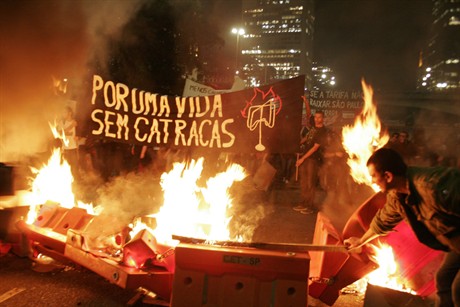
The first protest saw thousands hit the streets, ending only after a small group steered the crowd onto a nearby highway, with some individuals lighting plastic traffic barriers on fire to which the riot squad quickly responded. A second protest within the week seemed to have the police response step back, and passed tranquilly enough, though a visible police force was present. The third, however, resulted in police chasing protesters away from disrupting traffic at a bus terminal—tear gas was thick in the air. The fourth protest, however, seemed to turn the tide in more ways than one. By this point, similar protests had begun to spring up across the country—more than 25 cities in Brazil had events called for on Facebook. In Sao Paulo, the police responded with strong force—riot squads, cavalry, tear gas, pepper spray, rubber bullets—one news agency alone had seven reporters detained. Another reporter was assaulted by police even as she stood next to her supervisor, attempting to explain the situation. Within the week, the cities of Rio de Janeiro and Belo Horizonte would also have clashes with the police. Public discourse began to shift, and signs of solidarity became more visible as residents of Sao Paulo began hanging white sheets in support of protesters from their balconies.

Some might wonder about the magnitude of such protests just for transit costs, but the scope has widened. Police violence such as seen in Rio de Janeiro, São Paulo and Belo Horizonte is nothing new. A broken education system, a healthcare system struggling to meet the needs of an entire population, amongst other issues. Topping the list for many people is concern about the large amount of money allotted for World Cup preparation—preparation which, in addition to building or remodeling near all the stadiums required for the more than 10 sites which will host games in 2014, has also included attempts at relocating the favelas, slum communities, which sit near stadium sites.
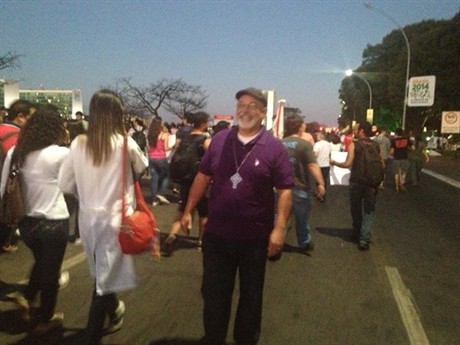
The Episcopal Anglican Church in Brazil (IEAB) has not stood idly by during this tension-filled time—the country has not seen protests of this magnitude since the 1980s, towards the end of the military dictatorship. Primate Mauricio Andrade recently took to the streets with thousands in the capital city of Brasília, and Provincial Secretary Arthur Cavalcante of São Paulo joined parishioners and friends from other denominations alike at one of the demonstrations. As Bishop Mauricio stated on Facebook,
“…the people come to the streets to demonstrate and emphasize the issue of social inequality in Brazil. When a country invests millions in (re)construction football (soccer) stadiums, and on the other hand the people suffer with public transport, schools and hospitals. It is our duty as the Church to maintain the prophecy and all our prophetic indignation during this moment of the people’s cry.”
Primate Mauricio Andrade (pictured below) and IEAB Bishop Francisco Assis da Silva (Diocese Sul-Ocidental) are quite actively involved with the National Council of Christian Churches in Brazil (CONIC), which recently released a statement condemning police violence during the protests. In addition to clerical support, many laity also hit the streets and showed their support.
As per where it will go from here remains to be seen. Now that the transit costs have returned to normal, there is a simmering tension of sorts—people are upset with the years’ worth of decisions not to invest in education, public health and the millions being spent in preparation for the World Cup. The Brazilian people, many of whom still remember the time of the military dictatorship, are waking up to their own strength—and yet this awkward time also begs the balancing act of how do we work together despite our differences: dissenters, pro-government supporters and everyone in between. Especially during this tenuous time, the Episcopal Anglican Church in Brazil is praying for its people, and vowing to be right at their side as we walk boldly towards the future.