The Anglican Communion is represented at the United Nations in Geneva and New York because the United Nations can be a place where governments, international humanitarian institutions, non-governmental organisations and faith communities can come together, not only to express concerns about the world’s difficulties but to take practical action to transform injustice and to respond to people in need.
The most recent report from the United Nations High Commissioner for Refugees (UNHCR , June 2015) is that there are, in our world, approximately 59.5 million refugees and displaced people.
Come, you that are blessed by my Father, inherit the kingdom prepared for you from the foundation of the world; for I was hungry and you gave me food, I was thirsty and you gave me something to drink, I was a stranger and you welcomed me, I was naked and you gave me clothing, I was sick and you took care of me, I was in prison and you visited me. - Matthew 25
Our common calling as communities of faith, acting together in the service of humanity, is to respond each of those almost 60 million people not as a component of a terrifying statistic, but as 60 million individual people, created and loved by God.
As 60 million tragedies; 60 million stories which we can help to change from death to life, from fear to hope, from desperation to dignity as, together, we Welcome the Stranger.
Our Christian tradition challenges us to receive each new person as if they were Christ himself.
In December 2012 the United Nations High Commissioner for Refugees, Antonio Guterres, drew together a group of religious leaders from around the world together with faith-based humanitarian organizations, academics and government representatives from countries for a Dialogue on the theme of “Faith and Protection.” The Anglican Communion was represented at the Dialogue by Archbishop Daniel Deng of the Episcopal Church of South Sudan and Sudan.
As the High Commissioner noted in his opening remarks, “…all major religious value systems embrace humanity, caring and respect, and the tradition of granting protection to those in danger. The principles of modern refugee law have their oldest roots in these ancient texts and traditions.”
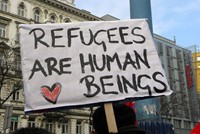
Photo Credit: Haeferl/Wikimedia Commons
Together they searched the scriptures of their respective religious traditions and found therein a rich spiritual resource and a profound shared understanding of the responsibility not only to feed the hungry and clothe the naked but to uphold human dignity.
At the conclusion of this landmark event, the High Commissioner embraced a recommendation for the development of a Code of Conduct for faith leaders, to welcome migrants, refugees and other forcibly displaced people, and to stand together against xenophobia.
In response to this call, between February and April 2013, a coalition of leading faith-based humanitarian organizations and academic institutions drafted the Affirmations, which aim to inspire leaders of all faiths to “welcome the stranger” with dignity, respect and loving support and to be a resource and a practical tool to foster support for refugees and other displaced people in their communities.
The call to “welcome the stranger,” through protection and hospitality, and to honour the stranger, or those of other faiths, with respect and equality, is deeply rooted in all major religions and our faiths demand that we remember we are all migrants on this earth, journeying together in hope.
A core value of my faith is to welcome the stranger, the refugee, the internally displaced, the other. I shall treat him or her as I would like to be treated. I will challenge others, even leaders in my faith community, to do the same.
From “Welcoming the Stranger: Affirmations for Faith Leaders”
The Affirmations, which have been translated into Arabic, Chinese, French, Hebrew, Russian and Spanish, inspire leaders of all faiths to “welcome the stranger” with dignity, respect and loving support. Faith communities around the world are invited to use the Affirmations and supporting resources as practical tools to foster support for refugees and other displaced people in their communities.
World religious leaders signed the affirmations at the 9th Assembly of Religions for Peace in Vienna, Austria, in November 2013 and it was signed by the Archbishop of Canterbury, the Most Revd and Rt Hon Justin Welby, at the 10th Assembly of the World Council of Churches in Busan, South Korea.
In some places we Anglicans find ourselves as both those who welcome and as those who arrive as, for example, in the Episcopal Church in South Sudan and Sudan. In South Sudan the churches are playing a crucial role in responding to a humanitarian crisis where some 4.6 million people will be facing critical food insecurity by July and over 2 million people have been displaced from their homes since 2013*.
In this continuing emergency the church has spoken with a strong voice against tribal divisions which continue to exacerbate the conflict and has welcomed, protected, fed and provided hope for thousands who have fled their villages with nothing.
Anglicans and Episcopalians around the world are committed to Welcoming the Stranger in their life, witness and in loving service and the initiative is one of the two mandated priorities for the Communion’s Mission to the United Nations Institutions.
The Revd Canon Flora Winfield is Anglican Communion Representative to the United Nations institutions in Geneva.
*UN Office for the Coordination of Humanitarian Affairs, South Sudan Humanitarian Bulletin, 29 May 2015
“Welcoming the Stranger: Affirmations for Faith Leaders