Fr Richard Wilson recently returned to Melbourne after walking the Via Francigena, an ancient pilgrim route running from Canterbury to Rome. He met Christ each day of the walk, he reflects, even though he did not always recognise him.
When I sensed, resisted, then finally accepted the call to go ‘on pilgrimage’, and having chosen the Via Francigena, I did not really know what to expect. I was determined that it should not be another bushwalk, but I had no particular goals in mind. Despite the build up of anticipation, I was determined that it should be real, not romantic.
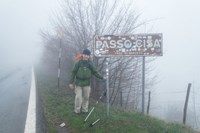
Photo Credit: Submitted by Richard Wilson
The Via Francigena runs from Canterbury to Rome, passing through France and Switzerland. It has followed the Roman road network for more than 1,300 years. The earliest detail of the route we have is the journal of Sigeric, Archbishop of Canterbury who walked it from Canterbury to Rome in 990 to receive the Pallium from the Pope, stayed three days, then walked back.
I walked the last third, from Pavia, just south of Milan, to Rome. A journey of roughly 700 kilometres. 36 days on the track, thirty two of them walking. An average of 25 kilometres a day. The longest day was 34 kilometres with a 1,000 metre ascent. I carried a 10kg backpack with one change of clothes, a sleeping bag, an iPad, camera, toiletries and not much else. I lost about eight kgs.
I stayed in ostelli, hostels for pilgrims, that have been established, mainly in the places Sigeric records as his stopping points. There was very little English spoken in the countryside.
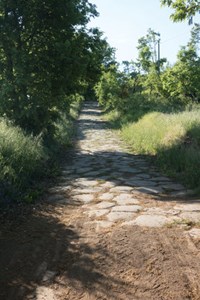
Photo Credit: Submitted by Richard Wilson
The track is a combination of walking track, footpaths, roads large and small and a bit of cross-country through farms and forests, and one WWII airfield. There were lots of dogs. A few were friendly.
I passed through Lombardia, Emilia Romagna, Tuscany and Lazio. Tuscany is a beautiful place to walk and equals its reputation, but Lombardia and Emilia Romagna are beautiful too. Lazio? Meh. These details are only the travelogue. The practical side was easy or manageable. There were incidents along the way but no disasters.
The hardest part was not physical but mental and spiritual. For the first two weeks I travelled alone and stayed pretty much by myself in the ostelli. I became, after a while, very lonely. The welcome at the first monastery I stayed in, in Piacenza, was barely civil. There was no one with which to share the experience of ‘pilgrimage’, except in prayer, and after two weeks that seemed a bit one-way.
At the same time I became used to the rhythm of the road, the daily imperative to be up and out, packed, laced up, fed and watered and on the next leg. It was not, in one respect, contemplative. Sometimes it was dangerous, especially where the track followed major roads. Once or twice I really felt like throwing in the towel. I was never more than a half day’s train ride from Rome.
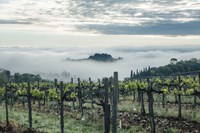
Photo Credit: Submitted by Richard Wilson
But then things began to change. Closer to Rome I began to meet other pilgrims on the track and in the ostelli. We were able to share meals together in the towns where we stopped and came to know a little of each other’s stories. Language was still a bit of a barrier as most of the people I met were not English speakers. We got by.
As my mood lifted I became aware how much of a change it was to be out of community. I had, of course, left family, friends and colleagues behind. I had not anticipated what a difference that would make; and I have done a lot of solo work-based travel. These little connections with others along the way made a profound difference. As my Italian improved, so did my capacity to get closer to the people I met in the towns and villages along the way in shops, restaurants, cafes and at the ostelli.
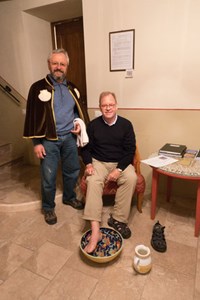
Photo Credit: Submitted by Richard Wilson
The turning point was at Abbadia Isola. The ostello there is run by volunteers of the Confraternita di San Jacopo. A retired couple from Bologna, Ettore and Lydia, were on duty. I rang the bell, Lydia opened it and greeted me with the greatest warmth and largest smile. I was shown a comfortable dormitory in which I was the only occupant. They gave me iced tea and biscuits. I had a couple of hours to change and wash, look around the very old church before dinner, which they provided. But not before welcoming prayers complete with Ettore washing my feet and kissing them! Then to dinner for three. A home-cooked meal and an engaging conversation, in broken Italian on where we were from, family, the other pilgrims we had met and so forth. In the morning, breakfast was the same. After a blessing from me, which they insisted on, I was sent on my way with fruit and bread in my pack and tears in my eyes, overwhelmed by their hospitality and friendliness.
The reality of God’s presence with me on this journey was becoming palpable. There were numerous occasions when something I needed appeared, seemingly, out of nowhere. Even a physiotherapist when I had a troublesome foot!
By journey’s end I had a renewed appreciation of these three things: community, hospitality and provision. Provision never failed. Hospitality and community were denied me at the start, almost as a lesson. Hospitality then became abundant. Community for me was never really resolved. I don’t think you can walk a pilgrimage without being, for a large part of it, alone. The aloneness reminded me of how valuable family and the community of the church and work are.
I didn’t experience any visions, no ethereal figures of Mary or St Roch (patron of the Via Francigena). While I didn’t always recognise him, I met Christ every day. Sometimes I was able to be Christ for someone else. That was real.
Fr Richard Wilson is an assistant priest at St Peter’s Eastern Hill in East Melbourne, Australia. This reflection first appeared on the Anglican Diocese of Melbourne’s website.