Vongai Mkaronda reports,
Anglican Church of Papua New Guinea
Introduction:
On 8 June 2011 a gender sensitisation workshop was conducted at CTC (Christian Training Centre) for the Ifane Mission District of Popondota Diocese in the Anglican Church of Papua New Guinea (ACPNG). The workshop was attended by 35 community and chapel leaders from the 10 chapels and communities that make up the Ifane Mission District. Among these were 8 youths (2 male and 6 female), 6 men and 22 women. Included in these figures were members of the religious societies. Also present were 27 other interested observers.
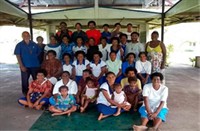
Archbishop Joe, Mother Washita with some of the Gender Sensitisation
Workshop Participants and the Facilitators
This gender sensitization workshop was held under the auspices of the ACPNG Gender Program as an inauguration of the Gender Program in the Diocese of Popondota in line with the ACPNG Gender Policy which spells out that Dioceses will be at the forefront of the gender work. The inauguration of the gender program was a culmination of several months of planning by the Gender Program working with ministry arms in the Diocese and tapping on the expertise of Anglicare. Ifane Mission District, which is just outside Popondetta town, was identified in the planning process as the place to pilot the gender program for the Diocese of Popondota.
The ACPNG Gender Policy envisions complete change of heart, mind and attitude to enable respect, equal participation and shared leadership in all aspect of the Church ministry. Archbishop Joseph Kopapa, in his opening remarks said that, “the Church needs to take the challenge by owning the Gender Policy and participate without any reservation in ensuring the body of Christ is gender sensitized and inclusive; enabling the gifts of God to fully manifest through gender equality and participation for the strengthening of the body of Christ. The ACPNG is proud to be the first Christian Church in PNG to have a policy on gender. However, the Gender Policy will remain only a paper if the church as a whole does not take any action in implementing it. This gender sensitisation workshop is a first step in implementing the Gender Policy and ensuring the Church as the centre for gender justice.”
The Archbishop strongly emphasised the need for gender sensitization and inclusion be targeted in the family unit throughout the ACPNG, as the family is the foundation of a healthy and prosperous society and base for avoiding and addressing all issues that are gender related.
The Workshop
As a sensitization workshop, the workshop set out to determine the participants’ knowledge base of gender; undertake a participant’s knowledge based-analysis of gender and an identification of the gender issues in the community.
Participants Knowledge of Base of Gender:
- Asked what they knew and understood by gender, participants pointed out that:
- Gender is about balanced creation – equality between men and women from the time of creation
- Man, woman, boy and girl
- There is an uninformed understanding of gender in communities and the church
- Gender is about sexual behaviour
- Gender is about role and power that God intends for men and women
- ‘Source’ of women – characteristics of men and women (biological differences of men and women from creation
- Women’s rights
- Men fighting with their wives - violence
After this presentation, the facilitators briefly discussed with the participants what gender is all about pointing out that:
- There is a difference between sex and gender.
- Sex is what God has created and cannot be changed. The biological make up of an individual.
- Gender is what society has created through the roles that are given to men and to women in the society. These roles can be changed.
Knowledge Base Analysis and Identification of Gender Issues:
Participants were put in groups to identify what they considered to be gender issues in their homes and communities.
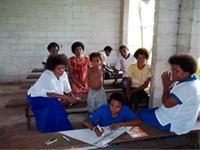
Participants working in groups
Violence is associated with:
- wife beating leading to family separation, suicide, running away from family
Alcohol Abuse
- Leads to violence in the family and in the community, misuse of money, armed robberies, disabilities, bad feelings (shame) leading to reduced community participation, imprisonment, broken homes, chasing family, disturbances in families and communities, need advice and counselling
Finance
- selfishness, the children and mother suffer, there is no proper diet, fights in the home, school fees is not paid creating problems for the children, homes are disturbed
Literacy
At the end of the group presentations, the participants prioritized Violence, Alcohol Abuse and Finance as key areas for gender education in the Ifane Mission District.
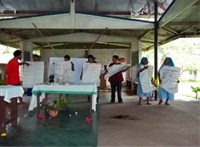
Participants Prioritising Gender Issues
Conclusion
The Gender Sensitization Workshop was successful in that the leaders were able to express their understanding of gender and identified the issues around gender affecting their societies. We were also able to determine where the community is at with regards to Gender and the gaps that we have to fill. There is willingness by the community and church leaders in Ifane to combat gender injustices.
Collaboration among the different specialised bodies will be vital in moving the gender program and agenda in the communities. The success of this workshop is largely as a result of the cooperation of the Gender Program with Anglicare StopAids, Diocesan HIV/AIDS, the Diocesan Bishop and the Parish Priest. There are many cross cutting issues which will best be served by fuller collaboration with Community Development and the Literacy Project.
As the way forward in this pilot project, the gender program will device training programs for the leaders on Violence, Alcohol and Drug Abuse, and Finance Literacy. We will seek to develop these jointly with Community Development, HIV/AIDS, Anglicare and the Literacy Project. Given that most of the participants come from areas influenced by the Church (Anglican and non Anglican), we notice that the Bible has a lot of influence on gender understanding. We will seek the help of Newton Theological College to develop theological training materials on gender.
Acknowledgements:
The Gender Program would like to acknowledge the following for making this workshop a success:
Archbishop Joseph Kopapa
Steve Raurela, Anglicare StopAids
Stella Kopapa, Diocesan HIV/AIDS Coordinator
Fr Atkins, Parish Priest for Ifane Mission District
Newton Theological College for logistical support
Archbishop Joe with Vongai, Steve, Stella and Fr Atkins