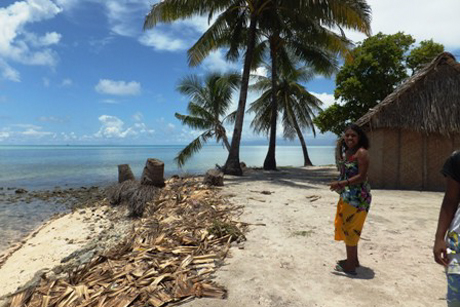
Photo Credit: Anglican Overseas Aid
[Trust.org] Auki,Malaita Province, Solomon Islands – In the Solomon Islands, where the sea level rise of 8 millimetres per year is almost three times the global average, survival of communities on the low-lying atoll of Ontong Java is already threatened.
But identifying a new home for those who are eventually displaced will be difficult, even in this sprawling nation of more than 900 islands located northwest of Fiji, in the southwest Pacific region.
“The number one obstacle will be access to land,” said Hudson Kauhiona, deputy director of the government’s climate change division, in the capital, Honiara. “It is going to be a very big challenge when moving people.”
More than 87 percent of land in the Solomon Islands is owned by indigenous clans and extended families and the remaining fraction is administered by the state. The majority of the population of 550,000 live by subsistence agriculture in rural areas and less than 20 percent are in formal employment. Therefore, customary land is vital to people’s food security, livelihoods and provision for the next generation.
The full article can be found here