[ACNS] The Archbishop of Canterbury, Justin Welby, has joined other Anglican primates and church leaders in calling for an immediate ceasefire in the ongoing conflict between Israel and Hamas in the Gaza strip. The Israeli military action, dubbed Operation Protective Edge, has so far claimed the lives of more than 1,360 mostly civilian Palestinians and 56 Israeli soldiers; in addition to two Israeli civilians and a Thai civilian working in Israel.
Israel’s military operation, which began on 8 July, has two stated aims: firstly, to prevent rockets being launched from Gaza into Israel; and secondly, to locate and destroy “terrorist tunnels” through which Hamas and militant groups are launching attacks from Gaza into Israel. But the built-up nature of Gaza combined with Hamas’ tactic of basing missile launching sites in civilian areas, such as schools and clinics, means that civilian casualties have been high.
The UN estimates that around 74 per cent of the Palestinians killed in the current conflict are civilians, including 243 children and 131 women. And yet the conflict shows no sign of abating. On Thursday, Israel announced that it was calling up 16,000 military reservists, taking the total number deployed in Operation Protective Edge to 86,000.
While church leaders, politicians and diplomats speak out about the crisis from a safe distance, in the centre of the storm is the Ahli Arab Hospital, a ministry of the Diocese of Jerusalem. This 80-bed hospital has been serving the residents of Gaza since 1882; and since the conflict began has been providing shelter to displaced residents as we as serving those injured.
Shelling has caused damage to the hospital’s ventilation system in the operating theatre and emergency room; while windows have been broken in many of the hospital’s buildings, including the new diagnostic centre. Part of the hospital’s exterior wall, in the laundry area, has been destroyed by the impact of air strikes in the vicinity of the hospital; and the main steam pipeline has been destroyed. Shrapnel has hit many of the hospital’s inpatient’s rooms.
As a result, the hospital is without hot water. And, because of damage to the strip’s electricity power generating station, it is having to rely increasingly on self-generated electricity, despite a severe shortage of fuel.
Hospital staff are working around the clock to provide immediate and critical care to the patients being brought in for treatment. Its surgical teams are dealing most with explosion injuries and traumas, including abdominal injuries, bone injuries, chest injuries, soft tissue injuries and different types of burns. An international medical team are currently awaiting permission to enter Gaza to supplement the hospital’s staff.
Earlier this month, the Diocese of Jerusalem launched an Emergency Appeal for funds to sustain the hospital’s work. It needs fuel to generate electricity to keep operating theatres open and to power essential life-saving equipment for critical-care patients; it needs medical supplies, medicine, antibiotics, orthopaedic supplies, food, linen, beds, mattresses and pillows. And once the current fighting eventually subsides, it will require new equipment for post-war treatment and rehabilitation and additional staff.
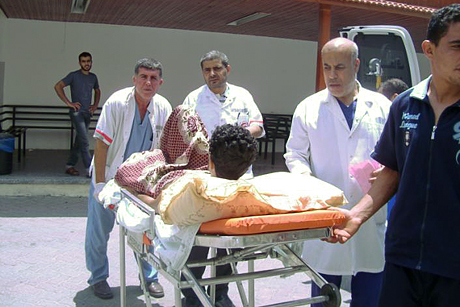
medical teams receive a patient at the Ahli Arab hospital
“There is an immediate need for repairs to ensure patient safety. Al Ahli Hospital has become a refuge for families who are suffering, homeless and afraid,” said Anne Lynn, president of the American Friends of the Episcopal Diocese of Jerusalem. “The doctors, nurses and support staff at Al Ahli Hospital, despite exhaustion and fear, despite deplorable conditions and chronic shortages, still provide compassionate care to each and every patient. They deserve, and have, our respect, our prayers and our support.”
The Diocese of Jerusalem warned against using the conflict to generate anti-Israel sentiment. The Revd Canon John Organ, chaplain to Anglican Bishop in Jerusalem, Suheil Dawani, said that “It doesn’t help to be pro this and anti the other. We need to be pro-Israeli and pro-Palestinian. We don’t have to take sides; but we do have to stand up for justice and stand against this occupation.”
The Archbishop of Canterbury, Justin Welby, has had “many private contacts” with staff of the hospital. Following the latest update, he has spoken publicly of his concern.
“You can't look at the pictures coming from Gaza and Israel without your heart breaking. We must cry to God and beat down the doors of heaven and pray for peace and justice and security,” the Archbishop said. “Only a costly and open-hearted seeking of peace between Israeli and Palestinian can protect innocent people, their children and grandchildren, from ever worse violence.
“My utmost admiration is for all those involved in the humanitarian efforts on the ground, not least the medical team and staff at Al Ahli Arab Hospital. Providing relief and shelter for those displaced is a tangible expression of our care and concern, and I encourage Church of England parishes and dioceses, as well as the wider Communion, to pray for them and support the Diocese of Jerusalem's emergency appeal.”
He continued: “While humanitarian relief for those civilians most affected is a priority, especially women and children, we must also recognise that this conflict underlines the importance of renewing a commitment to political dialogue in the wider search for peace and security for both Israeli and Palestinian. The destructive cycle of violence has caused untold suffering and threatens the security of all.
“For all sides to persist with their current strategy, be it threatening security by the indiscriminate firing of rockets at civilian areas or aerial bombing which increasingly fails to distinguish between combatants and non-combatants, is self-defeating.
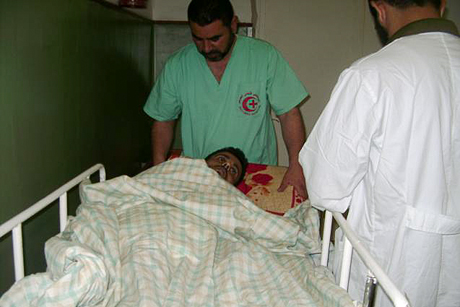
Medical teams treating a patient at the Ahli Arab hospital
“The bombing of civilian areas, and their use to shelter rocket launches, are both breaches of age old customs for the conduct of war. Further political impasse, acts of terror, economic blockades or sanctions and clashes over land and settlements, all increase the alienation of those affected.
“Populations condemned to hopelessness or living under fear will be violent. Such actions create more conflict, more deaths and will in the end lead to an even greater disaster than the one being faced today. The road to reconciliation is hard, but ultimately the only route to security. It is the responsibility of all leaders to protect the innocent, not only in the conduct of war but in setting the circumstances for a just and sustainable peace.”
And the Archbishop was clear that criticism of the Israeli government must not be used as an excuse for anti-Semitic attacks: “While it is acceptable to question and even disagree with particular policies of the Israeli government, the spike in violence and abuse against Jewish communities here in the UK is simply unacceptable.
“We must not allow such hostility to disrupt the good relations we cherish among people of all faiths. Rather we must look at ways at working together to show our concern and support for those of goodwill on all sides working for peace.”
Echoing the prayer of Pope Francis, Archbishop Justin concluded by saying: “Let us pray to the Prince of Peace who so suffered in a land of violence that hearts may turn to peace and the innocent be helped.”
His words were echoed by the Presiding Bishop of the Episcopal Church in the United States, Katharine Jefferts Schori, who said that “the continued and escalating violence in the land of the Holy One, the slaughter of innocents by actions of both sides, and the rigidity and absence of true political leadership is making the world weep.
“God weeps as well, as brother kills brother. Will we permit Cain and Abel to play out their brief and bellicose act, or will we demand an end to this depravity? No one will live in peace in the Middle East – or the world – while this carnage continues. Pray for peace, shelter the innocent, support every humanitarian response, and insist on an end to this inhumanity.”
The Primate of Brazil, Archbishop Francisco de Assis da Silva, said: “Only international pressure can push for a definite ceasefire, and permit real and serious negotiations for establishing a Palestinian state and an Israeli state to coexist in mutual respect without hostilities.
“Not every Israeli is a zionist, and not every Palestinian is an anti-semite. There exist many organizations and movements which have also posited for seeking understanding and recognition in both peoples’ right to each have its own state and self determination. Many ecumenical and interfaith initiatives have also sought this path as well.”
He continued: “Armed radicals do not serve as legitimate interlocutors for the construction of peace. The logic of war is unacceptable, and even more so when it kills children, destroys hospitals, schools and infrastructure, and negates the right to secure refuge.”
Archbishop Thabo Makgoba, Primate of the Anglican Church of Southern Africa, told ACNS yesterday that the violence was “a senseless, unnecessary conflict,” adding: “no war will bring peace and security to Israel and Palestine, in particular not when it involves the heartless use of brute force which has been deployed in the past week. The Israelis and the Palestinians can find a solution – now they must find one, and the international community needs to bring maximum pressure to bear on both to ensure they do.”
Additional reporting by Matthew Davies, Episcopal News Service
The Archbishop of Canterbury’s statement can be read here.