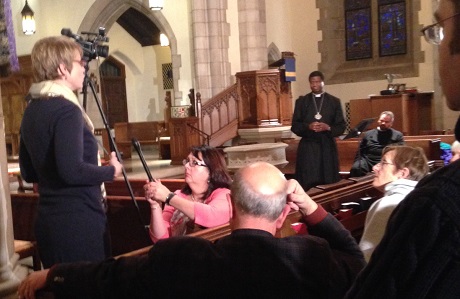
Photo Credit: Episcopal Diocese of Maryland
By M. Dion Thompson,
The Rt Revd Eugene Taylor Sutton brought members of his flock into a sacred space yesterday for what he knew would be a difficult, yet necessary conversation about race.
“I find that most whites say, ‘I don’t like to talk about it’. And I find that most blacks also dread having this conversation,” said Sutton, the first black bishop in the Episcopal Diocese of Maryland. “But if the Church can’t have this conversation, who can and where can it happen?”
About 100 people gathered in the Cathedral of the Incarnation’s sanctuary in Baltimore for what the Revd Rob Boulter, acting dean of the Cathedral, said was a “time for some truth telling and some truth hearing.”
Many echoed Sutton’s reluctance to talk about a subject that has been in the national news since a Missouri grand jury decided not to indict a white police officer in the shooting death of Michael Brown, an unarmed, 18-year-old black man. That decision, and a similar one by a New York City grand jury, has sparked protests across the nation.
But, Sutton did not want to limit the conversation to those judicial decisions. He began by reading a list of nearly 20 unarmed black men who had been shot dead by police or security officers in the country over the last three years.
“We need to know why this is happening, and we want to talk about that,” he said.
Yesterday’s session ran the gamut of emotions. The Revd James Perra, who is white, noted his own personal difficulties with the issue, as well as the challenge of bringing this subject to his parish in Locust Point. Janet McMannis said even so-called white liberals fall into an us-versus-them mode when talking about race.
For others, the reluctance involved relating painful stories about having to give up a seat to a white person, or enduring the countless stings of rejection and suspicion. The Rev. Glenna Huber, who is black, said she was angry and tired of having to fight this issue year after year.
Still, others were impressed that the Church had decided to take on the issue.
“I’m so happy that we’re having this conversation today,” said Reba Bullock, president of the Maryland chapter of the Union of Black Episcopalians. “I personally feel that the Church has a moral obligation to change the hearts of people.”
The Revd Adrien Dawson said the Church was being “called out” to model what it means to be a diverse community. She also criticized Sutton and other Church leaders for not taking the lead in responding to the issue in the wake of the grand jury decisions. Sutton said he wanted to have yesterday’s conversation before making a formal statement.
Bishop Wolfgang D. Herz-Lane, of the Evangelical Lutheran Church in America, said America needs to have an intentional conversation about race. Herz-Lane, who was raised in Germany, said his country dealt with the terrible legacy of Adolph Hitler and Nazism only after having such conversations. The same was true in South Africa, he said, where the Truth and Reconciliation Commission helped that country confront its history of apartheid. Lacking such a similar conversation, America would never get to the heart of its struggle with racism, said Herz-Lane.
Sutton also noted that “an unholy alliance” of race, class and violence helps fuel the country’s problems. He described one study in which blacks and whites misidentified a black man as having been armed in a photo of a confrontation with a white man. In fact, it was the white man who was armed with a knife. The black man was unarmed.
“Racism is a disease and we are all infected, all of us to some extent,” said Sutton, who encouraged those attending to continue the conversation. And, he added to the mostly white gathering, “You don’t have to have a black person present to have a conversation about race.”
The Episcopal Diocese of Maryland is a Christian community of 21,500 households in 108 congregations covering 10 counties and Baltimore City; our purpose is to sustain our community of churches, congregations and ministries while living into our Baptismal Covenant to proclaim by word and example the good news of God in Christ, seek and serve Christ in all persons, and strive for justice and peace among all people, respecting the dignity of every human being. Please visit www.episcopalmaryland.org for more information. The Episcopal Church is a community of 2.4 million members in 100 nationwide dioceses, 10 overseas dioceses and six extra-provincial territories; www.episcopalchurch.org. The Anglican Communion is a global community of 77 million Anglicans in 38 member churches/provinces, including The Episcopal Church; www.anglicancommunion.org.
Editor’s note:
View the archive of the webcast online at http://episcopalmaryland.org/live-webcast-why-ferguson-matters-a-conversation-with-bishop-eugene-taylor-sutton-on-race-and-violence/
Follow the link below to see what the #FergusonMatters twitter stream looked like yesterday. Note on the bottom of some of the tweets you see the number of retweets and favorites. More than just the 1,200 followers of @episcomd were able to see these tweets. https://storify.com/RevWeb/why-ferguson-matters