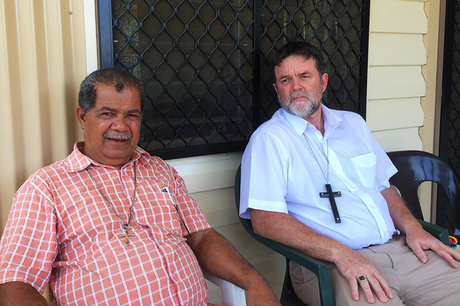
Photo Credit: Anglican Taonga
[Anglican Taonga] Archbishop [of the Anglican Church in Aotearoa, New Zealand & Polynesia] Philip Richardson has returned from a visit to Papua New Guinea enthused about the possibilities for greater regional Anglican co-operation - and convinced of the significance of the upcoming Missions Conference [from October 6-9].
He has brought back with him a vision for collaboration in mission, education, theological education and administration across the provinces of Australia, Melanesia, Papua New Guinea and [the] Anglican Church in Aotearoa, New Zealand & Polynesia.
Plus a conviction that the October Common Life Mission Conference could become a turning point not only for our own church’s commitment to overseas mission, but also a means whereby we “forge stronger and deeper links with our brothers and sisters in Polynesia, Melanesia and Papua New Guinea”.
The bishops will be there...
It’s certainly clear that the Mission Conference will provide a unique opportunity for missional connections to Papua New Guinea to be made at the highest level – the Henry and William Williams Trust is sponsoring the entire Anglican Church of Papua New Guinea House of Bishops (five bishops) to take part in that conference, which is being held in Kings College, Auckland.
The trigger for Archbishop Philip being in Papua New Guinea was the consecration on Sunday, 24 May, of the new bishop of Port Moresby, the Rt Revd Denny Bray Guka.
That consecration was held in St Martin’s Church, East Boroko (where Fr Guka had served for seven years) in front of a congregation of about 2000.
Archbishop Philip, who is chair of the Anglican Church in Aotearoa, New Zealand & Polynesia’s Missions Board, [preached the sermon] at the consecration at the invitation of the Primate, Archbishop Clyde Igara.
Coming of age
In many ways the service was a coming of age for the Anglican Church in Papua New Guinea. For the first time since it became independent of the province of Queensland in 1976, all its bishops are now Papua New Guinea nationals: Bishop Guka succeeded the last of the ex-pats, Bishop Peter Ramsden, who travelled from England to hand over the pastoral staff to him.
After the 24 May ordination, Archbishop Philip and Canon Robert Kereopa, who is the Executive Officer of our missions board, made a number of visits to parishes, and called at the headquarters of Anglicare Papua New Guinea.
Papua New Guinea is in the grip of one of the most serious HIV/AIDS epidemics in Asia and the Pacific.
While Anglicans comprise a relatively small percentage of Papua New Guinea’s 7.8 million population (27 percent of whom are Catholic) Anglicare Papua New Guinea has won international recognition for being the largest indigenous NGO working to turn back HIV in the country.
Our primary responsibility?
Archbishop Philip and Canon Robert also took part in an extended meeting with the ACPNG House of Bishops and representatives from the UK and Australian Anglican Boards of Missions.
They talked in general about pursuing greater co-operation across the provinces of Aotearoa, New Zealand and Polynesia, Australia, Melanesia and Papua New Guinea – and in particular, and at length, about pursuing greater regional collaboration in mission, education, theological education, and administration.
In his report to the house of bishops here, Archbishop Philip spoke of the “significant opportunity” he and Robert Kereopa see for that regional co-operation – “and, arguably, a primary responsibility on us to build those relationships.”
The missions conference in October, though, shapes as a key, he believes – not only to building regional co-operation, but to being “a real stimulus to the understanding of, and commitment to, overseas mission in our church.”