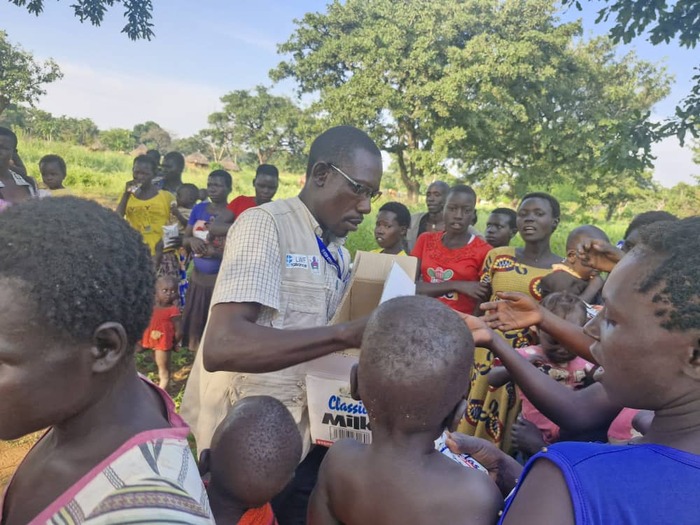
Photo Credit: Diocese of Kajo Keji.
The Bishop of Kajo Keji has made an appeal for humanitarian intervention, following surprise attacks between South Sudanese and Ugandan soldiers on Monday 28 July in South Sudan's Kajo Keji county.
The incident took place on shared borders in the Nyaingamuda area, Bori Boma of Kangapo II Payam, Kajo-Keji. News reports state that the violence claimed the lives of at least eight soldiers, between Uganda People’s Defense Force (UPDF) and South Sudan People’s Defence Force (SSPDF).
In a statement, the Rt Revd James Lule, Bishop of the Diocese of Kajo Keji, expressed “deep astonishment” about the incident, which has also displaced people in the region. An assessment by the diocese estimates that the increasing number of internally displaced persons include, households 2364, individuals 7915, children 2350, and the elderly: 830.
The church has been providing support, including searching for families, identifying lost or separated children, providing humanitarian assistance and spiritual comfort to those affected. Churches across Kajo-Keji have also been holding special solidarity prayers for peace, de-escalation or / and demilitarisation to allow freedom of movement and communities.
Bishop James’s statement explains “…the displaced are camped under trees, in schools, Churches, and health facilities without access to any source of food, clothing, cooking utensils and other basic needs. The displaced population is living in fear due to widespread rumours, misinformation and a negative propaganda of war (between the two forces) circulating uncontrollably.”
In a report by the New York Times, the Rt Revd Joseph Aba Nicanor, from the Episcopal Diocese of Liwolo also drew attention to the issue of displaced people saying: “Children went unattended as they got separated from their parents, the elderly remained scattered as they began to get out of the bushes to look for their unaccompanied kids, and the sick and injured had no medicine to be given.”
Bishop James Lule's statement this week has appealed for “… for humanitarian intervention, for peaceful resolution of conflicts by the warring forces, for protection of the civil population from any sort of violence, and for the warring parties to abide by humanitarian and international laws to spare the civil population."
Referring to Psalm 23:1-6 the statement continues: “We pray that the civil population remains resilient and recover from the traumatic experience. For God is the ultimate sustainer of humanity… We call upon all warring parties to demonstrate love for the people of the two sisterly nations. Any war must always be for a just cause of the common good of humanity. What do we gain from killing each other and destroying our long relationship?”
The bishops’ statement is important. For many years, the Diocese of Kajo Keji has been working to rebuild community life and support internally displaced people and refugees impacted by civil war. They are now living in a context of rising tension in South Sudan, a country where fragile peace is collapsing and where millions are facing hunger and displacement.
News reporting on the reasons for the clash on July 28 vary, with some suggesting that competing claims over the poorly defined boundary “often flare into small-scale fighting”. Other news reports describe this as a “rare clash” between the “longtime security partners” of South Sudan and Uganda.
A report by Bishop James Lule from the Diocese of Kajo Keji suggests that the contested area between the two countries (encompassing Nyaingamuda and Gobor) has been “disputed for decades, but past confrontations have been limited and brief in terms of the consequences.”
The report also notes that the Church is “fully aware that border disputes, although presented as mere territorial issues, are often exploited for political purposes. These tensions may be manipulated to stoke nationalist sentiments, distract the population from domestic issues and serve the interests of specific political actors. This places short-term political opportunism above the well-being of the population and hinders a peaceful, sustainable long-term resolution.”
Bishop James’s report urges:“We must resist divisive ideologies of violence or and military solution, and instead foster a culture of solidarity and genuine fraternity”. It affirms that the Diocese of Kajo-Keji “maintains active and deeply fraternal ties with the sisterly Church of Uganda in Moyo and the overall West Nile region.”
For more information
Read the full statement by the Bishop of Kajo Keji.
Read other news reports about this incident Reuters and The New York Times