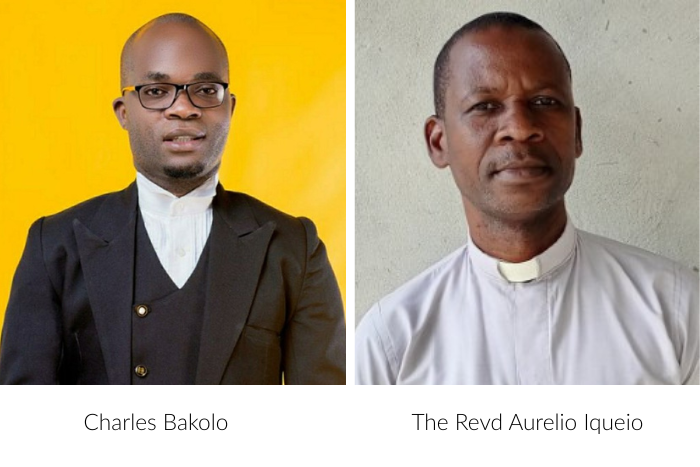
Green Anglicans Revd Aurelio Iqueio and Charles Bakolo will join other Anglicans at COP30 to advocate for creation care.
They will call governments to listen to the voices of the Amazon and indigenous wisdom, work with faith groups to strengthen resilience in communities on the front line of the climate crisis and to keep promises on climate finance so that all nations can thrive. They will urge governments to speed the just transition away from fossil fuel dependency and commit to changing international finance systems to protect the poorest people.
Revd Aurelio Uqueio is the Provincial Coordinator of Green Anglicans for Igreja Anglicana de Mocambique e Angola (IAMA). Charles Bakolo is the Provincial Environmental Coordinator for the Anglican Province of Central Africa and Ambassador for the Green Anglicans in Malawi. Ahead of the meeting, they spoke to Anglican News to share their hopes and advocacy priorities.
Hope for a productive COP30
Revd Aurelio Uqueio hopes this year’s COP will ‘strengthen’ the ‘global commitments to reduce greenhouse gas emissions’, work towards ‘fair climate financing mechanisms’ for ‘developing countries, such as those on the African continent’ and present initiatives for ‘the introduction of renewable energies, sustainable and resilient agriculture’ and ‘environmental preservation.’
He believes the location of this year’s COP will help to ‘emphasise the importance of the Amazon in the global climate agenda.’
Charles Bakolo says ‘deepest hope is that this gathering will mark a turning point where the global community moves decisively from eloquent commitments to transformative action. For too long, African communities have borne the devastating consequences of a climate crisis they did little to create.’
He dreams that COP will be a place ‘where the voices of the most vulnerable are not merely heard, but truly shape the decisions being made, where climate finance flows directly to grassroots initiatives rather than being trapped in bureaucratic channels, and where adaptation solutions are led by the very communities who understand their contexts best.’
Revd Aurelio intends to advocate for support to adapt to climate change, including the provision of ‘fair climate finance’, the ‘preservation of forests and biodiversity’ and the protection of ‘climate activities and environmental defences.’
Similarly, Charles remarks that his advocacy in Brazil will be centred on the ‘lived realities of millions’ across Africa. ‘Climate justice must move beyond rhetoric to guarantee that African nations receive meaningful support for loss and damage already occurring in our communities. Water security has become an existential crisis as changing rainfall patterns devastate communities that have depended on predictable seasons for generations. Food security demands urgent attention as smallholder farmers struggle to feed their families amid increasingly erratic weather. And crucially, we must create genuine pathways for youth engagement in climate decision-making, which is why Climate YES continues to mobilise young African voices who will inherit the consequences of decisions made today.’
Environmental justice is an intrinsic pillar of the Christian faith
Revd Aurelio sees caring for creation as ‘a moral and ethical responsibility’ which reflects the Christian values of ‘compassion’ and ‘justice’. He sees nature as a ‘source of spiritual inspiration and connection with the divine’ which calls for active protection as ‘God’s creation’.
Echoing the sentiment of faith in God and caring for His creation as inseparable practices, Charles states that ‘the relationship between my faith and creation care is not tangential but foundational to everything I do. I serve as a steward, because I believe we are entrusted with God's creation, and this sacred responsibility demands action.
‘When I witness communities without clean water, when I see crops failing because the rain no longer comes when it should, when I meet young people anxious about their future on a degraded planet, I recognise these as profound moral and spiritual failures. Environmental destruction is an assault on human dignity and an affront to the Creator. My work in banning thin plastics in Malawi, coordinating creation care networks, and advocating at global forums is simply faith in action. To love our neighbours means ensuring they have water to drink, food to eat, and a habitable planet to call home. Creation care is not an addendum to my faith, it is the embodiment of the Gospel's call to justice, mercy and stewardship.’
About Green Anglicans
Green Anglicans is an extension of the Environmental Network of the Anglican Church of Southern Africa which over the last several years has become a movement for environmental justice. The movement has since spread to further regions of Africa and seeks to resource, inspire and equip Anglicans to care for creation.
Find out more about what Anglicans are advocating for at COP30.
Find out more about the Lungs of the Earth initiative
Find out more about Green Anglicans.