‘Women’s experiences in war and conflict need to be heard’, say the organisers of the in-person meeting of the International Anglican Women’s Network (IAWN).
Hosted by the Episcopal Church in Jerusalem & the Middle East, IAWN gather in Amman, Jordan, from February 2 to 5, focusing on the topic of 'Women in War'. The aim of the meeting is to discuss the experiences of women in places of conflict and their role in peace-building processes.
Hearing the voices of women on this topic is vital in an age where women are continuously exposed to the dangers of violence and fatality in war. 15% of women globally live within 50 kilometres of a conflict zone and while the atrocities of war impact all people, some predominantly affect women and girls. Those living in places of conflict can also face rape, disrupted access to healthcare and forced migration, adding further risks, such as those associated with human trafficking.
The vital role of women in peace-building is the focus of IAWN’s dialogue in Jordan. The group seek to advance recommendations made in the 2000 United Nations Security Council resolution 1325, which reinforced the importance of women’s voices being involved in peace-building processes and decision-making.
All over the world, women are serving as mediators, activists, diplomats, organisers and advocates for change, focusing on sustainable, holistic and long-term solutions. Yet they are often underrepresented when it comes to formal dialogue and decision-making processes.
It’s something IAWN would like to see change, because the impact of women in peace-making can be significant. As an example, United Nations Women reports that peacebuilding efforts in Mali and Niger’s border zones found that women’s participation in conflict prevention rose in recent years, helping resolve more than 100 conflicts regarding local natural resources.
In conflict zones, Care International found that ‘Eight in ten women are finding ways to make communities safer, seven in ten are providing health services, and 46% are diversifying incomes to care for their families. However, only one of 18 peace agreements signed in 2022 included signatures from a women’s organisation. This means women’s needs are not considered in conflict resolution and recovery.’
During the time in Jordan, the group are spending time in prayer and pilgrimage to spiritually significant sites in the Holy Land. These include: Mount Nebo, a significant Judeo-Christian site where Moses viewed the Promised Land, the Madaba, an ancient mosaic map of Jerusalem and the Baptismal Site known as ‘Bethany Beyond the Jordan’ – a UNESCO World Heritage site that is widely recognised as the authentic location where John the Baptist baptised Jesus of Nazareth.
A dynamic group of women are involved in facilitating and speaking at this important dialogue, all of whom have strong experience in areas of conflict and peace-building work. These include: Susan Rantisi Barhoum (a member of IAWN from the Province of the Episcopal Church of Jerusalem & the Middle East), June Butler (one of the IAWN Steering Committee and Mothers Union Zonal Trustee for all Ireland (joining virtually), the Revd Dr Paula Nesbitt (a researcher, published author and member of the Steering Group of the Anglican Communion Peace and Justice Network) and Hera Clarke-Dancer, Deputy-chair of IAWN and an Indigenous Māori woman from the Anglican Church in Aotearoa, New Zealand & Polynesia, among others.
Members of the steering committee met with local members of the church and civil leadership, including Senator Haifa Najjar, Minister for Culture from the Upper House of the Jordanian parliament and the Venerable Canon Faeq Haddad, Archdeacon in Jordan and will continue these important dialogues through the rest of the time in Jordan.
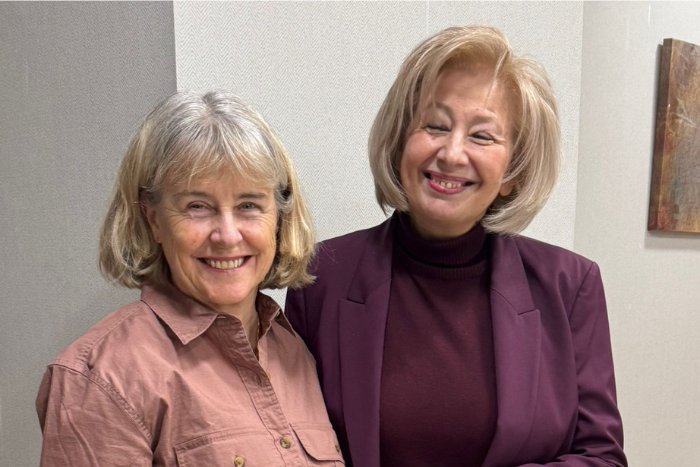
Chair of IAWN, Helen Van Koevering (left), presents a small gift of a scarf and Anglican Communion pin badge to Senator Haifa Najjar, Minister for Culture, from the Upper House of the Jordanian parliament (right).
The meeting plans to produce a report ahead of the Anglican Consultative Council meeting (ACC19) later in 2026, the purpose of which is to enlighten member churches about the importance of women having a voice in peace-making as well as having equal opportunities for education so they can use their gifts and perspectives for the benefit of all.
Speaking of the meeting in Jordan, Mandy Marshall, Director for Gender Justice at the Anglican Alliance and the Anglican Communion, says: ‘Many women in our Anglican churches around the Communion face the brutality of war. It is key that we listen to the voices of those with lived experiences or who continue to live in places of war and conflict. We want to inspire churches to ensure women's meaningful participation in peace and security conversations. We want women at the table. We want churches to empower women to be involved in peace-making because it’s good for everyone, especially those who have the experience to speak with authenticity about being in contexts of conflict.’
Revd Helen Van Koevering, Chair of IAWN, urges that we cannot afford not to involve women in leadership in peace dialogues. ‘Investing in women’s meaningful, decision-making roles is one of the most effective, evidence-based strategies for building durable peace and national stability. Because when women lead, peace lasts longer. In sharing our stories, we follow in the footsteps of Biblical women as agents of peace, justice, reconciliation and community-builders – women like Abigail, Deborah, Esther, the women at the tomb, and the early church leaders like Priscilla, Phoebe, Euodia and Syntyche. Scripture affirms women as trusted leaders in peace-making that protects communities, restores relationships, and advances God’s peace.’
Martha Jarvis, the Anglican Communion Special Representative to the United Nations, says, 'Part of my role in the Anglican Communion is to represent Anglican voices and values in international discussions as well as to support member churches in their local advocacy work. I’ve seen firsthand the difference many women make in situations of conflict and the transformation they can bring as peacemakers. This focus of IAWN’s meeting has huge potential for women globally and as churches relate to the United Nations in a time of international tension. It's also highly relevant to the work of the Anglican Peace and Justice Network and we look forward to increasing collaboration across the Communion's networks.'
More about the International Anglican Women’s Network
The International Anglican Women’s Network (IAWN) promotes gender equality, justice and works to prevent and end gender-based violence around the Communion. It is a unique network that brings together women from across the Communion to share the ongoing work and challenges in each province for awareness, encouragement and inspiration.
See a short video about the meeting in Jordan.
Find out more about the International Anglican Women’s Network here.
Find out more about resolution 1325 (the Women, Peace and Security agenda) here.
Have a story to share? Get in touch with genderjustice@anglicancommunion.org to share your story regarding women in war and peace-making.