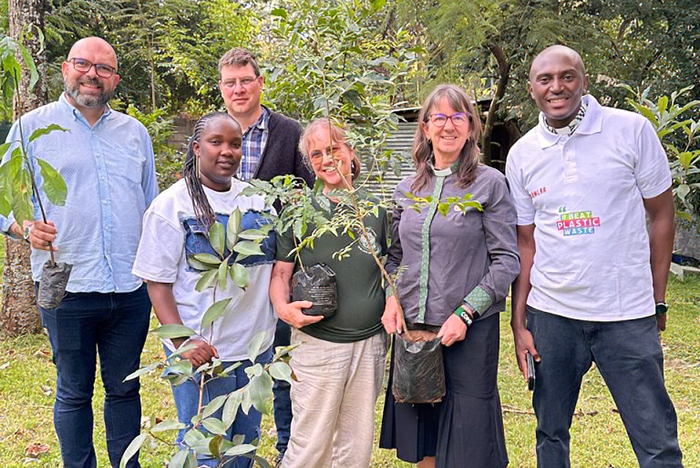
Photo Credit: Green Anglicans
Four years on from a single tree planted at the Lambeth Conference, the Communion Forest now stretches from mangroves and meadows to prayer gardens and prairies – and a new A to Z gathers its stories from Australia to Zimbabwe.
The Communion Forest, the Anglican Communion’s global creation-care initiative, celebrates its fourth birthday on 3 August, having grown from a single symbolic tree into a diverse, worldwide movement of Anglicans caring for creation.
The Communion Forest is a global initiative comprising local activities of forest protection, tree growing and ecosystem restoration, undertaken by provinces, dioceses and individual churches across the Anglican Communion to safeguard creation.
The initiative was launched on 3 August 2022, when bishops gathered in the garden of Lambeth Palace during the Lambeth Conference to plant a symbolic tree. It was designed to connect, equip and inspire Anglicans to protect and restore the ecosystems around them – a living expression of the Fifth Mark of Mission: to strive to safeguard the integrity of creation and sustain and renew the life of the earth.
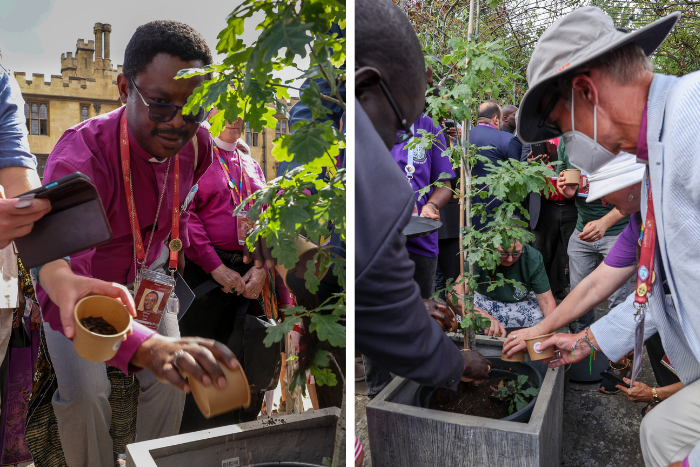
Bishops and their spouses add soil to the base of the tree during the symbolic tree planting ceremony at the Environmental and Sustainable Development day at Lambeth Palace during the 2022 Lambeth Conference.
Photo: Neil Turner
Four years on, that work spans ecosystems as varied as mangroves, wetlands, grasslands and coastal habitats. The Communion Forest describes itself as a ‘practical, spiritual and symbolic response to the environmental crisis’, with activities decided locally so that communities discern what creation care means in their own place, responding to their own ecology, culture and circumstances.
The Anglican Alliance has been coordinating the project for the last four years, connecting with Member churches and environmental groups around the world.
Coinciding with the anniversary, they have released a new 'A to Z of the Communion Forest'. From Australia to Zimbabwe, it gathers stories about how Anglican churches are growing the forest in their setting.
In the Philippines, Anglicans have restored coastal ecosystems, including a mass mangrove planting in the Visayas. In the Democratic Republic of the Congo, Bishop William Bahemuka Mugeni has chosen to protect natural forest rather than clear it for cocoa. In England, 100 acres beside the River Wye are being restored at Bartonsham Meadows, while prairie restoration that began in the Diocese of Kansas has spread to other US dioceses.
The Communion Forest team note that 'one of the most distinctive things to have emerged over the past four years is the way the Communion Forest has helped Anglicans connect practical care for biodiversity with spiritual life'.
In Gippsland, Australia, communities plant ‘prayer trees’ where people leave written prayers. In Palmas, Brazil, a parish that had planned to clear a wooded site for a new church instead preserved the trees and created a prayer garden. After a Communion Forest exhibition at Westminster Abbey, visitors’ prayer slips – printed on wildflower-embedded paper – were planted outside, and the lawn later blossomed with wildflowers as a dormant native orchid re-emerged.
In Bangladesh, clergy, young people and lay communities are being encouraged through sermons, revival meetings and tree planting to understand care for creation as part of their spiritual calling. Confirmation candidates are invited to plant and tend trees.
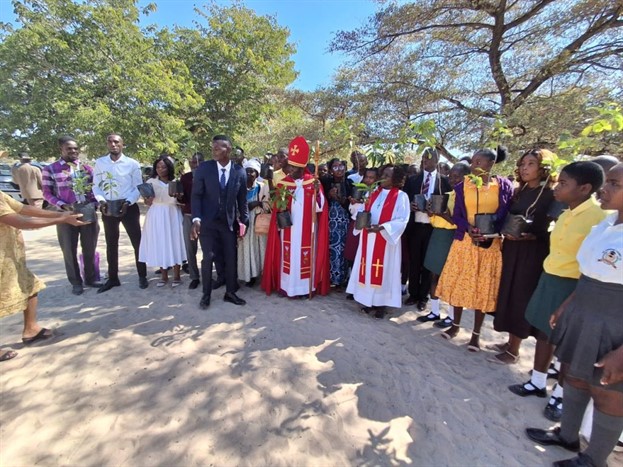
Confirmation candidates, clergy and church leaders gather with saplings before planting 40 trees in Namibia as part of the Communion Forest.
These stories capture something fundamental about the Communion Forest: biodiversity is not simply an environmental issue to be addressed, but part of creation with which Christians are called into relationship.
The Bishop of Brasilia, Maurício Andrade said: ‘The Communion Forest may be the most inclusive and accessible initiative within the Anglican Communion,’ he said, describing how it embraces environmental action at every scale, personal or institutional, and lets individuals and communities ‘discover their unique vocation in caring for God’s creation.’
Anglican voices have carried that experience into international forums, including the UN Convention on Biological Diversity, where practical action on the ground gives the Church credibility when it calls on governments and others to act.
‘The Communion Forest gives credibility to the Anglican Communion’s advocacy in spaces like the UN Convention on Biodiversity,’ said Global Facilitator Nicholas Pande. ‘It shows we are not just telling others what to do – we are planting, restoring and protecting creation ourselves.’
As it marks four years, the Communion Forest is inviting Anglicans to explore the A to Z and consider their own response. It sums up that purpose in three lines:
To plant is to hope
To restore is to heal
To protect is to love
Explore the Communion Forest and its resources